EGYM’s Mobile applications are an integral part of the EGYM fitness ecosystem that keep members engaged with their training programs. They offer a holistic workout experience through personalized training, activity feeds and health metrics.
EGYM’s goal is to provide the world’s best experience for members in their fitness journeys and offer a cutting edge feature-set around workouts, activity and health. While, at the same time providing an extensible platform that allows customers to put their own brand and their specific set of features front and center. And to choose from a wide range of partners who can provide their content and functionalities directly into their EGYM apps.
We are committed to making it smooth and easy to bring your own functionality into the EGYM branded member app where they reach beyond what the core platform offers. For this reason, we created a concept called “Micro Web Applications” (MWAs). MWAs leverage web technologies to allow the modular deployment of custom functionality in a platform agnostic way.
This documentation will explain the concept and provide you with a step-by-step guide on how to integrate your custom functionality into the EGYM app.
EGYM provides an entry point for the partners to embed their own solutions into applications used by trainers or end users
Partners can build web applications under the guidance of the EGYM engineering team to make apps naturally connected to EGYM's mobile application and deliver the same look and feel
Build user journeys in which web based features are seamlessly connected with native features and doesn't need extra actions from end user (such as explicit login into web app)
Partners can deliver changes and new features to the product independently and according to their own timelines.
Micro Web Applications (MWA) are an approach to integrate client specific functionality into EGYM's mobile applications and achieve a near-native experience. End users will not even notice that certain parts of the application are built utilizing web technologies.
We looked at different options, such as plain web views, progressive web applications or adding service workers to the web applications and using aggressive caching on the device. But all of these techniques are brittle when it comes to edge cases, such as interoperability between web and native features or spotty internet connections. And some of them tend to be not well supported on all platforms (e.g. service workers on iOS).
The solution to all of these problems is to deploy a progressive web application into the device itself. Micro web applications are packaged and distributed as part of the EGYM member application. They are loaded onto the customer’s phone and behave no different from native code in terms of look & feel and snappiness, while being nicely isolated from the native code.
It’s important to note, that a Micro Web Application can not just be a “new tab” in the application. We are able to mix your Micro Web Apps with elements of our native application. So one example of that is possible is to e.g. display a “card” with your MWA’s content on the user's Home Screen right next to other native cards.
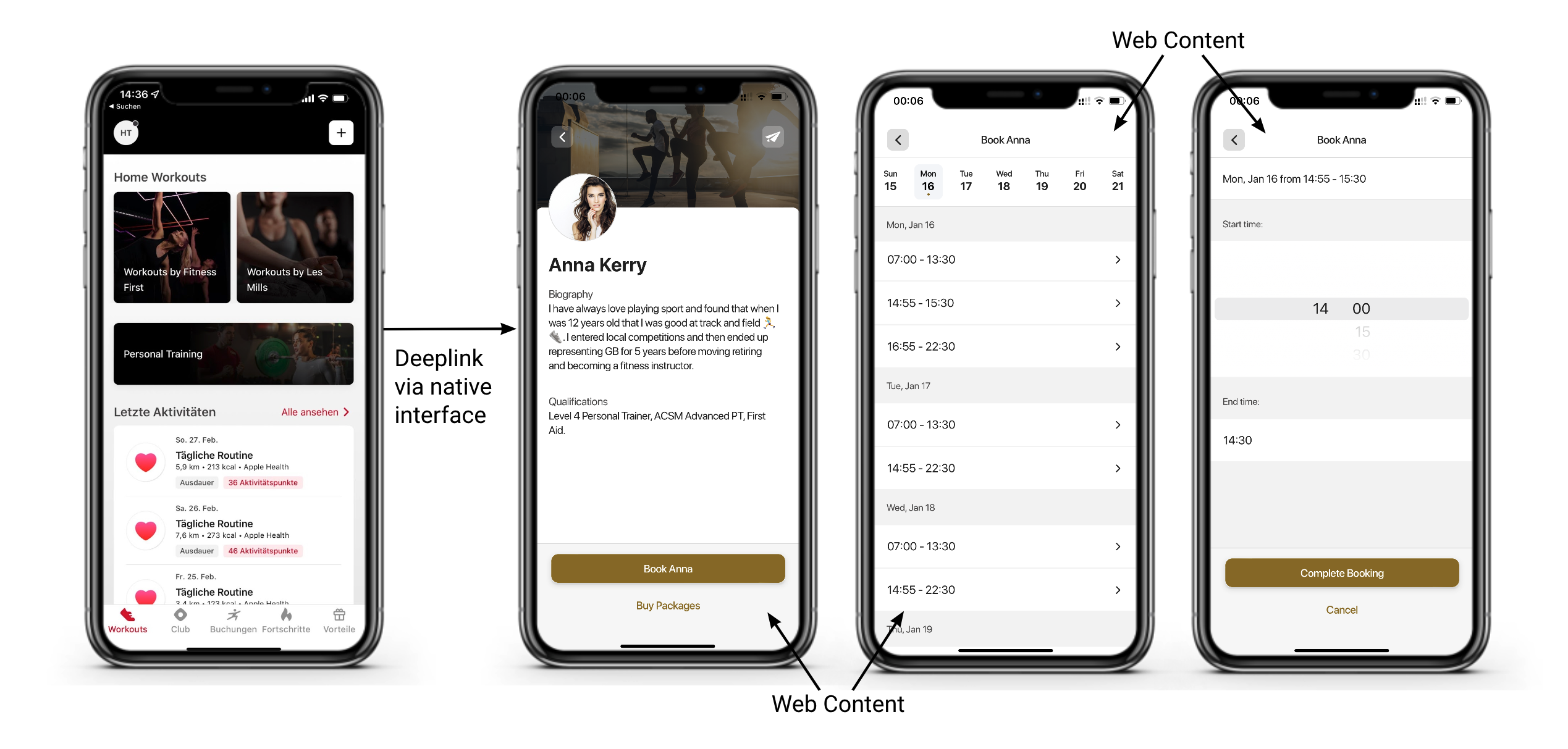
EGYM has decided to integrate with a product called Ionic Portals to deploy your Micro Web Applications into the EGYM app.
Micro web applications bring the most value when they are considered as small, self-contained units of functionality that perform a specific task. Some good use cases for micro web applications include but are not limited to:
- Group class schedule and booking
- Personal training appointments
- Customer self-service
However, a MWA might not be a good fit for complex business workflows where multiple components are tightly interconnected (such as the user sign-up flow with account linking and verification in an external membership management system). Dependencies to business features implemented in native application or 3rd-party systems will prevent web apps from being extended and released independently, this would lead to increased complexity of the overall solution and thus lower benefits of the technology.